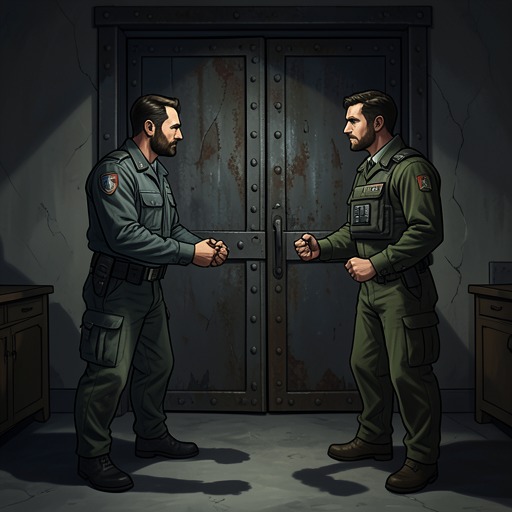
Sal
The Power of the DogSal is both a Green Beret colonel and a made member of the New York mob, a combination that makes him an unusually direct link between military force and organized crime. Decorated for service in Vietnam, he brings the authority of a career soldier into mob dealings: he checks visitors for weapons, serves as a potential source of lethal enforcement, and later commands a disciplined armed team. Yet the novel also presents him as a practicing Catholic who wears a Saint Anthony medal and trusts in the saint’s protection. The distance between that faith and his work is not a puzzle he resolves by leaving either world; it is a contradiction he openly inhabits.
Identity and Introduction
Art Keller remembers Sal from Vietnam, where he was one of the Special Forces men who attended Mass whenever he was not out killing people. Sal was an Italian man from New York, and his military service earned him many medals. The description of him as both a colonel in the Green Berets and a made man is not merely a colorful résumé: it explains why people in the mob take his presence seriously. In the restaurant encounter with Sean Callan and O-Bop, Sal steps away from the group outside, approaches them, and checks both men for weapons before inviting them in for lunch. The measured pat-down, including a check down to their ankles, makes the welcome conditional on his establishing control.
That entrance also gives Callan a glimpse of Sal’s authority before he knows its full extent. O-Bop identifies him as a senior military officer as well as a mob insider, and explains that if the organization decides to remove someone, Sal could carry out the task. Sal’s role therefore occupies a boundary between the respectable procedures of a meeting and the violence that can follow it. He can receive visitors with formal courtesy while making plain that their safety depends on the people who have admitted them.
Faith and the Vietnam Past
Art’s memories of Sal complicate the familiar separation between religious practice and violence. Sal went to Mass on Sundays when he was not engaged in killing, and the apparent inconsistency did not trouble him. In a drunken discussion, Art objected to Sal’s conviction that killing Vietcong amounted to doing God’s work. Sal’s reasoning was that communists were atheists who sought to destroy the Church, so fighting them was a duty rather than a sin. The disagreement reveals a moral framework that turns political and military violence into religious defense.
Sal made that conviction personal by showing Art the Saint Anthony medal he wore on a chain beneath his shirt. He said the saint kept him safe and urged Art to get a medal of his own. Art declined. The small object gives concrete form to a difference between the two men: Sal carries a visible token of protection into a life of repeated danger, while Art cannot adopt the assurance it represents. The novel does not suggest that the medal prevents violence or absolves Sal of responsibility. Instead, his continued devotion sits beside his soldiering and mob work, exposing how faith can coexist with, and even be used to justify, lethal action.
Mob Dealings and Reputation
Sal’s name carries practical weight in the mob’s business. When Jimmy Peaches explains how he obtained a telephone number connected to a proposed drug deal, he says Sal supplied it. Callan is uneasy, since he suspects that if Big Paulie Calabrese intends to punish them over the deal, Sal could have arranged the setup. The suspicion is Callan’s, not proof that Sal has betrayed them; the scene nevertheless shows that his position makes him a plausible intermediary in both business and danger. A number provided by Sal is not neutral information to Callan. It may open a door, or lead the men who trust it into a trap.
The restaurant meeting gives that reputation a more immediate expression. Sal checks Callan and O-Bop for weapons himself, then leads them into the private room. His manner is procedural rather than openly threatening, but the search establishes the terms of entry. In these scenes, his authority depends not only on the possibility of violence but also on his ability to make violence part of ordinary business: introductions, appointments, and negotiations proceed under the knowledge that he can enforce the consequences.
The Sea of Cortez Operation
Later, Sal approaches Callan with a job offer. Callan refuses, saying he no longer does that kind of work, and Sal clarifies that this assignment is not about taking a life but saving one. He then works with Art to plan an approach by water. They study detailed maps and decide that a fishing boat can carry the team south at night, from where they will transfer to Zodiacs and land on the beach. The plan depends on the tide: at low water, the beach could extend hundreds of yards, leaving the raiders exposed before they reached the houses.
The team that accompanies Sal is equipped for a heavily armed assault. The men wear Kevlar vests over black jumpsuits and carry machine guns or rifles, pistols, knives, and grenades. The account presents them as outside resources whose origin Art does not know, while their equipment makes clear the scale of force Sal has assembled. During the entry, his men advance through alternating squads: one provides cover while the other moves forward, then they switch roles. After three rotations, one reaches the side of the house, attaches a charge to the door, and the others enter. The sequence ends with three brief bursts of gunfire and silence. Sal’s military experience here appears not as biography alone but as a method of coordinated movement, disciplined firing, and controlled entry.
Final Confrontation and Narrative Role
Sal’s cooperation with Art does not erase their place in a violent world. After John Hobbs makes a call to Venezuela, Sal goes to clean things up; the narration does not specify what that entails, so the episode leaves the nature and result of his task unstated. Near the novel’s end, Sal is present when Nora Hayden tells Art that he killed the man she loved and that she never loved him. Nora hands Art a gun. Sal looks back and warns the shooter to act, then draws a second gun and aims it at Art from behind. The passage confirms Sal’s participation in an immediate threat against Art, though it does not establish the outcome of the confrontation.
Taken together, Sal’s appearances trace a consistent capacity to cross roles without leaving either behind. He is a soldier who brings military organization to a private operation, a mob member whose name can make an invitation suspect, and a Catholic who carries a saint’s medal while accepting violence as duty and professional work. The novel does not resolve these identities into a single explanation. Their coexistence is the point: Sal’s faith, discipline, and capacity for force belong to the same character, and his alliances remain contingent on the demands of the moment.